
Wellhealth How to Build Muscle Tag: Complete Indian Guide (2026)


The Wellhealth How to Build Muscle Tag is a comprehensive fitness philosophy that goes beyond simply lifting weights. It combines scientifically proven strength training principles; optimal nutrition particularly adapted for the Indian diet and recovery strategies rooted in both modern sports science and ancient Ayurvedic wisdom.
Unlike Western muscle-building programs that focus almost exclusively on gym equipment and protein supplements, the Wellhealth approach recognizes that most Indians build their best physique using a combination of:
- Desi protein sources: daal, rajma, paneer, eggs, chicken, and fish
- Progressive resistance training: bodyweight to barbell, gym or home
- Ayurvedic recovery: ashwagandha, shatavari, proper sleep rituals
- Holistic wellness: stress management, gut health, and mental strength
Whether you are a college student training at home, a working professional going to a gym 4 times a week, or a woman wanting to get stronger without bulking, this guide covers every scenario with precision.
The Science of Muscle Growth
Before diving into workouts and diet plans, understanding why muscles grow makes every decision clearer and more effective.
Muscle Hypertrophy What Actually Happens
When you perform resistance exercises whether pushing a barbell, lifting dumbbells, or doing bodyweight squats you create microscopic tears in your muscle fibres called micro-tears. This is not damage in the harmful sense; it is a controlled stimulus.
Your body responds to this stimulus by activating satellite cells specialized muscle stem cells that rush to the site of micro-tears, fuse with existing muscle fibres, and rebuild them thicker and stronger than before. This process is called muscle hypertrophy.
Three conditions must all be present for hypertrophy to occur:
1. Mechanical tension: The muscle must be challenged under load. This is why progressive overload (gradually increasing weight or reps) is the single most important training principle.
2. Metabolic stress: The “pump” you feel during training, caused by blood pooling in the muscle. This metabolic environment signals the body that the muscle is being heavily used and must grow.
3. Muscle damage: The micro-tears mentioned above. These trigger the repair and growth response.
Without all three, muscle growth stalls. This is why doing the same workout with the same weights for months produces no results your body has already adapted.
How Genetics and Hormones Affect Your Results
Testosterone and growth hormone are the primary anabolic (muscle-building) hormones. Men naturally have 10–20 times more testosterone than women, which is why men typically build muscle faster and at greater volume. However, this does not mean women cannot build significant muscle they absolutely can. Women gain strength and muscle definition, and their lower testosterone actually protects them from “bulking up” accidentally.
Indians and South Asians, on average, tend to have slightly lower testosterone levels compared to some Western populations, a fact rarely discussed in Indian fitness media. This is one reason why
Ayurvedic herbs like ashwagandha (a proven testosterone booster in clinical studies) are particularly valuable for Indian men pursuing muscle building.
3 Pillars: Training, Nutrition & Recovery
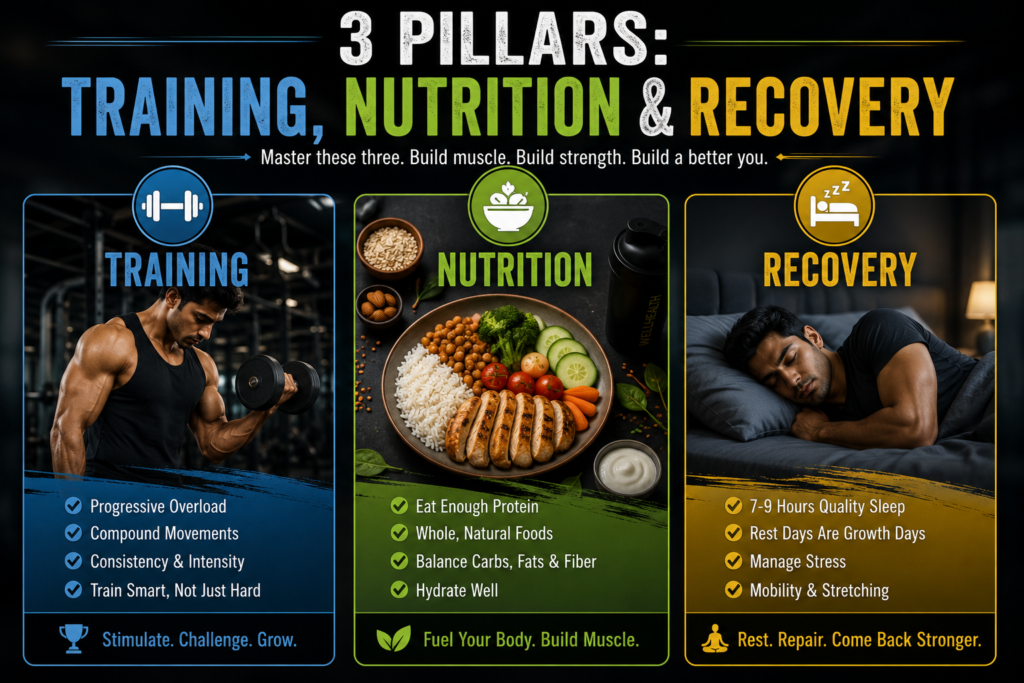
Every successful muscle-building program rests on three pillars. Neglect any one and progress slows dramatically.
Pillar 1: Training (The Stimulus)
Training provides the signal to your body that muscle is needed. Without the right training stimulus, no amount of protein or supplements will build muscle.
Key training principles:
Progressive Overload: The most important principle in all of strength training. Every week or two, you must increase either the weight lifted, the number of reps, the number of sets, or reduce rest time between sets. Without progressive overload, your body has no reason to grow.
Compound Movements First: Multi-joint exercises like squats, deadlifts, bench press, overhead press, and pull-ups recruit multiple muscle groups simultaneously. They should form the backbone of every session. Isolation exercises (bicep curls, tricep pushdowns) come after.
Training Frequency: Each muscle group should be trained 2–3 times per week for optimal growth. A push-pull-legs split (PPL) or upper-lower split achieves this efficiently.
Volume: Research shows that 10–20 sets per muscle group per week is the optimal range for hypertrophy. Beginners start at the lower end; advanced lifters work toward the higher end.
Pillar 2: Nutrition (The Building Material)
Muscle is made of protein. Without enough dietary protein and overall calories, your body cannot build new muscle tissue regardless of how hard you train.
Key nutrition principles:
Caloric Surplus: To build muscle, you must eat more calories than you burn. A surplus of 300–500 calories per day is ideal: enough to support muscle growth without excessive fat gain. Eating too far above maintenance gains fat without proportionally more muscle.
Protein Priority: Protein is the non-negotiable cornerstone. Aim for 1.6–2.2 grams of protein per kilogram of body weight daily. For a 70kg person, that is 112–154 grams of protein per day.
Carbohydrates for Fuel: Carbohydrates are the primary fuel for intense weight training. Low-carb diets significantly impair training performance and therefore muscle growth. Rice, roti, oats, sweet potato, and banana are excellent training fuels.
Healthy Fats for Hormones: Dietary fat is essential for testosterone production. Never go below 20% of total calories from fat. Ghee, almonds, walnuts, eggs, and sesame seeds are excellent sources.
Pillar 3: Recovery Where Growth Actually Happens
Muscles do not grow in the gym. They grow during recovery specifically during sleep, when growth hormone peaks and protein synthesis accelerates. Training breaks muscle down; recovery builds it up. Without adequate recovery, you are only breaking down without rebuilding.
Key recovery principles:
Sleep 7–9 hours: Non-negotiable. Growth hormone secretion peaks during deep sleep. Chronic sleep deprivation of even 2 hours reduces muscle protein synthesis by up to 18%.
Rest days: 1–2 rest days per week are essential, not optional. Active recovery on rest days (walking, yoga, swimming) promotes circulation and speeds repair without adding stress.
Stress management: Cortisol, the stress hormone, is catabolic, it breaks down muscle tissue. High chronic stress directly impairs muscle growth. Pranayama, meditation, and adequate leisure are part of the Wellhealth muscle-building protocol.
7-Day Workout Plan; Male & Female Separate Tables
For Men: 7-Day Push-Pull-Legs (PPL) Split
| Day | Focus | Exercises | Sets × Reps |
|---|---|---|---|
| Monday | Push (Chest, Shoulders, Triceps) | Bench Press, Overhead Press, Incline Dumbbell Press, Tricep Dips, Lateral Raises | 4 × 8–12 each |
| Tuesday | Pull (Back, Biceps) | Deadlift, Pull-Ups, Barbell Rows, Face Pulls, Barbell Curls | 4 × 8–12 each |
| Wednesday | Legs (Quads, Hamstrings, Glutes) | Squats, Romanian Deadlift, Leg Press, Lunges, Calf Raises | 4 × 10–15 each |
| Thursday | Rest / Active Recovery | 30-minute walk, yoga, stretching | — |
| Friday | Push (Repeat, Increase Weight) | Same as Monday + increase 2.5–5 kg on main lifts | 4 × 8–12 each |
| Saturday | Pull (Repeat, Increase Weight) | Same as Tuesday + progressive overload | 4 × 8–12 each |
| Sunday | Legs (Repeat) + Core | Same as Wednesday + Planks, Hanging Leg Raises, Ab Wheel | 4 × 10–15 each |
Beginner modification: Start with 3 days/week (Mon/Wed/Fri) using full-body workouts for the first 8 weeks before transitioning to PPL.
For Women: 7-Day Strength & Tone Split
Women build muscle through the same mechanisms as men but benefit from slightly higher rep ranges and greater emphasis on glutes, hamstrings, and upper back.
| Day | Focus | Exercises | Sets × Reps |
|---|---|---|---|
| Monday | Lower Body (Glutes & Quads) | Squats, Hip Thrusts, Bulgarian Split Squats, Leg Curls, Glute Kickbacks | 4 × 12–15 each |
| Tuesday | Upper Body (Back & Arms) | Lat Pulldown, Seated Rows, Dumbbell Curls, Tricep Pushdown, Face Pulls | 3 × 12–15 each |
| Wednesday | Active Recovery | 30-minute walk, 20-minute yoga, foam rolling | — |
| Thursday | Lower Body (Hamstrings & Glutes) | Romanian Deadlift, Sumo Squats, Cable Kickbacks, Leg Press, Step-Ups | 4 × 12–15 each |
| Friday | Upper Body (Chest & Shoulders) | Dumbbell Bench Press, Overhead Press, Lateral Raises, Push-Ups, Chest Flyes | 3 × 12–15 each |
| Saturday | Full Body + Core | Deadlift, Assisted Pull-Ups, Planks, Pallof Press, Russian Twists | 3 × 12 each |
| Sunday | Complete Rest | Rest, nutrition focus, meal prep | — |
Home workout alternative for women: Replace barbell exercises with resistance bands, dumbbells, and bodyweight. Hip thrusts can be done with a chair and a backpack filled with books. Progressive overload still applies — increase band resistance or add reps each week.
Indian Diet Plan for Muscle Building
This is the section no competitor provides a complete 7-day Indian meal plan using foods available in every Indian and Pakistani kitchen, designed to hit the protein and calorie targets required for muscle growth.
Daily targets for a 70kg person building muscle:
- Calories: 2,800–3,200 kcal
- Protein: 120–154g
- Carbohydrates: 350–420g
- Fats: 70–90g
7-Day Indian Muscle Building Meal Plan
Day 1: Monday
| Meal | Food | Protein | Calories |
|---|---|---|---|
| Breakfast (8 AM) | 4 whole eggs scrambled + 2 multigrain rotis + 1 glass whole milk | 38g | 620 kcal |
| Mid-Morning (11 AM) | 1 cup moong dal chilla + 1 cup curd | 22g | 280 kcal |
| Lunch (1 PM) | 1 cup rajma + 2 rotis + 1 cup rice + salad | 28g | 650 kcal |
| Pre-Workout (4 PM) | 2 bananas + 1 scoop whey (optional) or 1 cup sattu drink | 18g | 320 kcal |
| Dinner (8 PM) | 200g chicken curry + 2 rotis + 1 cup dal + sabzi | 45g | 750 kcal |
| Before Bed | 1 glass warm milk + 1 tsp ashwagandha powder | 8g | 160 kcal |
| Total | ~159g | ~2,780 kcal |
Day 2: Tuesday (Vegetarian)
| Meal | Food | Protein | Calories |
|---|---|---|---|
| Breakfast | Paneer paratha (100g paneer) + 1 cup curd + 1 glass milk | 40g | 680 kcal |
| Mid-Morning | 1 cup roasted chana + 1 fruit | 14g | 250 kcal |
| Lunch | 1 cup chhole + 2 rotis + 1 cup rice + salad | 26g | 680 kcal |
| Pre-Workout | Banana + peanut butter toast (2 tbsp PB) | 12g | 380 kcal |
| Dinner | Soya chunks curry (100g dry) + 2 rotis + dal | 38g | 700 kcal |
| Before Bed | 1 glass milk + handful almonds | 12g | 240 kcal |
| Total | ~142g | ~2,930 kcal |
Days 3–7 follow the same structure alternating between chicken/fish days and vegetarian days. Key principle: every meal must contain a significant protein source. Never eat a carb-only meal.
Quick Indian Muscle Building Snack Ideas
- Roasted chana (100g = 19g protein, 360 kcal) perfect pre-workout
- Paneer cubes + chaat masala (100g paneer = 18g protein) quick post-workout
- Sattu drink (3 tbsp sattu + water + salt + lemon) 12g protein, traditional Indian pre-workout
- Boiled eggs (2 eggs = 12g protein) cheapest muscle food available
- Dahi (curd) (1 cup = 10g protein) probiotic + protein, aids digestion
- Moong dal soup (1 cup cooked = 14g protein) light, easy to digest
How Much Protein Do You Need? Indian Sources Table
Protein Requirement Calculator
Use this simple formula: Daily protein (grams) = Your weight in kg × 1.8
| Body Weight | Minimum Protein | Optimal Protein |
|---|---|---|
| 50 kg | 80g | 90–110g |
| 60 kg | 96g | 108–132g |
| 70 kg | 112g | 126–154g |
| 80 kg | 128g | 144–176g |
| 90 kg | 144g | 162–198g |
Indian Protein Sources: Complete Reference Table
| Food | Serving | Protein | Calories | Best Time |
|---|---|---|---|---|
| Chicken Breast | 100g cooked | 31g | 165 kcal | Post-workout |
| Eggs (Whole) | 2 eggs | 12g | 140 kcal | Breakfast |
| Paneer | 100g | 18g | 265 kcal | Any meal |
| Moong Dal (Cooked) | 1 cup | 14g | 212 kcal | Lunch/Dinner |
| Rajma (Cooked) | 1 cup | 15g | 225 kcal | Lunch |
| Chhole (Cooked) | 1 cup | 15g | 270 kcal | Lunch |
| Soya Chunks (Dry) | 50g | 25g | 180 kcal | Any meal |
| Roasted Chana | 100g | 19g | 364 kcal | Pre-workout snack |
| Curd (Full Fat) | 1 cup | 10g | 150 kcal | Post-workout |
| Whole Milk | 1 glass (250ml) | 8g | 150 kcal | Before bed |
| Fish (Rohu/Pomfret) | 100g cooked | 26g | 180 kcal | Dinner |
| Peanut Butter | 2 tbsp | 8g | 190 kcal | Pre-workout |
| Sattu | 3 tbsp | 12g | 120 kcal | Pre-workout drink |
| Tofu | 100g | 8g | 76 kcal | Any meal |
| Almonds | 30g (handful) | 6g | 170 kcal | Snack |
Key insight for Indian vegetarians: Combining complementary proteins (dal + rice, roti + dal, chhole + rice) creates a complete amino acid profile equivalent to animal protein. You do not need meat to build muscle but you do need to eat enough total protein from these sources.
Ayurvedic Supplements for Muscle: Ashwagandha & More
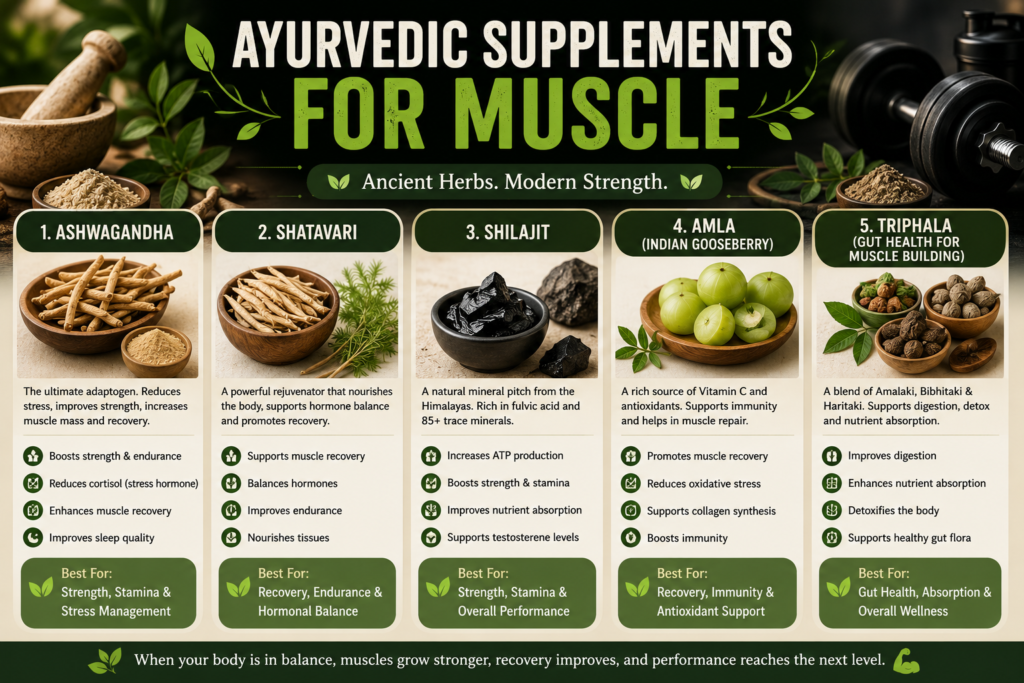
This is the section no competitor has written and it represents a genuine advantage for Indians pursuing muscle building. Ayurveda has a 5,000-year tradition of rasayana (rejuvenating herbs) that modern science is now validating through clinical trials.
1. Ashwagandha (Withania somnifera) The King of Muscle Herbs
Ashwagandha is the most scientifically studied Ayurvedic herb for athletic performance. Multiple randomised controlled trials have demonstrated its effectiveness:
- A 2015 study published in the Journal of the International Society of Sports Nutrition found that subjects taking 300mg ashwagandha root extract twice daily showed significantly greater gains in muscle strength and size compared to placebo after 8 weeks of resistance training.
- Ashwagandha supplementation has been shown to reduce cortisol levels by 28% directly lowering the catabolic hormone that breaks down muscle.
- Testosterone levels increased by 17% on average in men taking ashwagandha root extract in a 2019 study.
How to use: 300–600mg ashwagandha root extract daily. Available as powder (mix in warm milk before bed the traditional method) or capsules. KSM-66 and Sensoril are the most researched extract forms.
2. Shatavari (Asparagus racemosus): For Women
Shatavari is Ayurveda’s primary herb for women’s health, but its relevance to muscle building is underappreciated. It contains steroidal saponins that support healthy hormone balance in women, reduces exercise-induced fatigue, and improves recovery.
Women who include shatavari in their wellness routine report better recovery from strength training, reduced post-workout soreness, and more consistent energy levels.
How to use: 500mg–1g shatavari powder daily, mixed in warm milk or water.
3. Shilajit: The Mineral Powerhouse
Shilajit is a tar-like resin found in the Himalayas, composed of fulvic acid and over 80 trace minerals. It enhances mitochondrial function (energy production at the cellular level), improves testosterone levels in men, and increases muscle tissue ATP content directly improving workout performance.
A 2015 clinical study showed that men taking 250mg purified shilajit twice daily for 90 days had significantly higher testosterone and DHEA-S levels compared to placebo.
How to use: 150–250mg purified shilajit daily. Ensure it is purified (raw shilajit can contain heavy metals). Mix a pea-sized amount in warm water or milk.
4. Amla (Indian Gooseberry): Recovery & Inflammation
Amla is the richest natural source of Vitamin C, containing 20 times more vitamin C per gram than an orange. Vitamin C is essential for collagen synthesis (connective tissue repair), reduces exercise-induced oxidative stress, and accelerates recovery between training sessions.
How to use: 1–2 fresh amla daily, or 500mg–1g amla powder in water. Best taken in the morning.
5. Triphala Gut Health for Muscle Building
An often-overlooked fact: gut health directly impacts muscle building. Poor gut health reduces protein absorption meaning you can eat enough protein but your body absorbs less of it. Triphala (a combination of amla, bibhitaki, and haritaki) improves digestion, reduces inflammation in the gut lining, and optimises nutrient absorption.
How to use: 1 tsp triphala powder in warm water before bed, 3–4 times per week.
Ayurvedic Supplement Summary Table
| Herb | Primary Benefit | Dose | Best Time |
|---|---|---|---|
| Ashwagandha | Testosterone ↑, Cortisol ↓, Muscle Growth | 300–600 mg | Before bed with warm milk |
| Shatavari | Hormone Balance (Women), Recovery | 500 mg–1 g | Morning or before bed |
| Shilajit | Testosterone ↑, Energy, Mitochondrial Support | 150–250 mg | Morning |
| Amla | Recovery, Vitamin C, Collagen Support | 500 mg–1 g or 2 fresh fruits | Morning |
| Triphala | Gut Health, Protein Absorption | 1 tsp powder | Before bed |
Recovery: Sleep, Rest Days & Stress Management
Sleep: The Most Powerful Muscle Builder You Are Not Maximising
The majority of muscle protein synthesis happens during sleep — specifically during slow-wave (deep) sleep, when growth hormone is secreted in its largest daily pulse. Missing just one hour of sleep per night reduces muscle protein synthesis measurably over weeks.
Practical sleep tips for Indian lifestyle:
- Sleep by 11 PM: Growth hormone peaks between 10 PM and 2 AM. Sleeping after midnight significantly reduces this pulse regardless of total sleep duration.
- Avoid screens 1 hour before bed: Blue light suppresses melatonin, delaying deep sleep onset.
- Warm milk + ashwagandha before bed: This combination (a classic Ayurvedic nightcap) reduces cortisol and promotes deep sleep quality.
- Dark, cool room: Lower ambient temperature (18–20°C) significantly improves deep sleep quality.
- Consistency: Sleeping and waking at the same time 7 days a week is more important than any single “good night’s sleep.”
Active Recovery Strategies
On rest days, complete rest is not always optimal. Light activity that promotes blood flow without adding training stress accelerates muscle repair.
Best active recovery options:
- 30-minute walking: Promotes circulation, delivers nutrients to recovering muscles, reduces soreness
- Yoga (specifically Hatha or Yin): Improves flexibility, reduces cortisol, enhances mind-muscle awareness
- Swimming: Full body low-impact movement; particularly effective for recovery after heavy leg days
- Foam rolling: Self-myofascial release breaks up knots in muscle fascia, dramatically reducing next-day soreness
Stress and Cortisol Management
Cortisol, the primary stress hormone, is the enemy of muscle. It promotes muscle protein breakdown (catabolism), reduces testosterone, impairs sleep quality, and increases fat storage particularly around the abdomen.
Indians face unique cortisol challenges: high academic and career pressure, long work hours, urban traffic, and family obligations all chronically elevate cortisol.
Practical cortisol reduction strategies:
- 10 minutes of pranayama daily: Anulom-Vilom (alternate nostril breathing) has been clinically shown to reduce salivary cortisol significantly within a single session.
- Limit news consumption: Especially before training or before bed
- Social connection: Spending time with family and friends reduces cortisol
- Nature exposure: Even 20 minutes in a park significantly lowers cortisol
How Long Does It Take to Build Muscle?
This is the question everyone asks and few sources answer honestly. The timeline varies based on training status, genetics, consistency, and diet quality.
| Training Stage | Expected Monthly Muscle Gain | Notes |
|---|---|---|
| Beginner (0–1 year) | 1–1.5 kg/month | “Newbie gains” – fastest growth phase. |
| Intermediate (1–3 years) | 0.5–1 kg/month | Muscle gains slow as you approach your genetic potential. |
| Advanced (3+ years) | 0.25–0.5 kg/month | Progress becomes highly dependent on training, nutrition, and recovery optimization. |
| Women (Any Stage) | 50–60% of male equivalent | Due to lower testosterone levels, muscle gain is slower but still significant with consistent training. |
Visible Results Timeline
| Timeframe | What You Will Notice |
|---|---|
| Week 1–2 | Increased strength, better muscle pump, and improved energy levels. |
| Week 3–4 | Visible muscle fullness, and friends or family may begin to notice changes. |
| Month 2–3 | Clearly visible muscle definition along with significant strength gains. |
| Month 4–6 | Noticeable body composition changes with less body fat and more lean muscle. |
| Month 6–12 | A complete body transformation that becomes obvious to everyone. |
Important note: The scale may not change dramatically, or may even go up, in the first months of training. Muscle is denser than fat. 1kg of muscle occupies less space than 1kg of fat. Trust the mirror and how your clothes fit more than the scale.
Mistakes to Avoid
1. Not Eating Enough: The #1 Muscle Building Mistake
Most beginners under-eat while trying to build muscle. Building muscle requires a caloric surplus. If you are eating at maintenance or below, your body has no raw material to build new tissue, regardless of training quality.
Fix: Use the formula: Bodyweight in kg × 35–38 = approximate daily calories for muscle building. A 70kg person needs approximately 2,450–2,660 calories as a starting point.
2. Skipping Leg Day
Legs are the largest muscle group in the body. Training legs releases the highest levels of testosterone and growth hormone of any exercise which benefits ALL muscle groups, including arms and chest. People who consistently skip legs not only develop an imbalanced physique but miss the biggest hormonal signal available in weight training.
3. Changing Programs Every Week
Consistency with a single program for 8–12 weeks produces far better results than trying a new “amazing workout” every week. Your body needs time to adapt to a stimulus. Constantly changing the program prevents any stimulus from being applied long enough to force adaptation.
4. Neglecting Sleep Over Training
Adding a 6th gym session per week while sleeping only 5–6 hours produces worse results than training 4 times per week and sleeping 8 hours. Sleep is when growth actually happens. Choose sleep over extra training if you cannot have both.
5. Ignoring Gut Health
Poor digestion directly reduces the protein and nutrients you absorb from food. An Indian diet heavy in processed foods, excessive spice, and irregular meal timing disrupts gut flora and impairs protein absorption. Include dahi (curd), buttermilk, and triphala in your routine to maintain a healthy gut microbiome.
Conclusion
The Wellhealth How to Build Muscle Tag philosophy is ultimately simple: train progressively, eat enough Indian protein, sleep deeply, and recover wisely.
What makes this approach different from generic Western programs is the integration of India’s rich nutritional heritage: daal, paneer, rajma, sattu with Ayurvedic recovery wisdom ashwagandha, shatavari, amla and modern sports science principles. You do not need expensive supplements, a fancy gym, or Western foods to build an impressive physique. Everything you need is available in your local bazaar.
Start with one change today. Cook an extra serving of dal. Sleep 30 minutes earlier. Add one set to your push-up routine. Small, consistent actions compound over months into the body and the health you are working toward.
Written by Sarah Mitchell, Certified Nutritionist & Fitness Expert Well Health Organic | beautytipswellhealthorganic.com Last updated: June 2026